

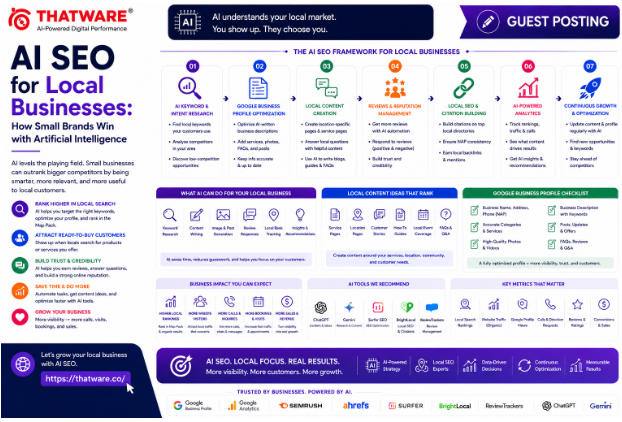
Here’s something that doesn’t get said often enough in the SEO industry: local businesses have a structural SEO advantage that large national brands don’t. They’re physically close to the people searching for them. They can build genuine community relationships that translate into organic authority signals. And they’re competing in geographic markets that are smaller and, in many cases, less aggressively contested than national search landscapes.
The problem is that most local businesses don’t exploit these advantages because they don’t have the resources or expertise to build a genuinely competitive local SEO presence. Traditional local SEO — claim your Google Business Profile, get some reviews, build local citations — is the floor, not the ceiling. And in competitive local markets, the floor is no longer enough.
AI-powered local SEO changes the resource equation considerably.
What Local Search Actually Involves
Local search is more complex than it appears from the outside. The “local pack” — those three business listings that appear at the top of Google’s results for local queries — is influenced by a combination of proximity, relevance, and prominence signals that interact in non-obvious ways. A business three miles from the searcher that has comprehensive, semantically rich content about the service being sought can outrank a business one mile away that has a sparse Google Business Profile and minimal web presence.
AI SEO for local businesses maps these dynamics specifically for your competitive market — not just general local SEO best practices, but the specific signals that correlate with top local pack rankings in your geographic area and service category.
Content That Wins Local Authority
Local content strategy for small businesses tends to fall into one of two failure modes. Either it’s completely generic (“welcome to our plumbing company, we serve the greater metro area”) — which provides no differentiation and builds no authority. Or it’s hyper-local to the point of being irrelevant to what users are actually searching for.
AI-informed local content strategy finds the productive middle: content that addresses real service-related search queries while establishing geographic and community relevance. Neighborhood guides that establish local expertise. Service content that addresses local conditions and regulations. Local resource pages that build genuine community value and attract local links naturally.
AI SEO optimization company services for local businesses also identify the specific informational queries local searchers use before making service decisions — the research phase that happens before someone calls a plumber or books a restaurant or visits a retailer. Capturing that research-phase traffic builds brand familiarity that makes commercial conversion significantly easier.
Reviews, Reputation, and Ranking Signals
Review signals — volume, recency, rating, and content — are among the most heavily weighted factors in local ranking. But most businesses approach review acquisition passively: ask customers occasionally, hope for good reviews, manage negative ones. This passive approach produces inconsistent review profiles that underperform relative to what’s possible.
AI-powered local SEO platforms can analyze the review patterns of local competitors, identifying what volume and recency levels correlate with top local pack positions, what review content characteristics (specific service mentions, geographic terms, staff names) appear most frequently in high-ranking businesses’ reviews, and what timing and acquisition approaches produce the best results.
This analysis transforms review strategy from a vague “get more reviews” goal into a specific, data-driven acquisition program with measurable targets.
The Compounding Advantage of Local Authority
Small businesses that invest in genuine local SEO — not just citation building and GBP optimization, but real semantic authority within their service category and geography — build an asset that compounds over time and becomes increasingly difficult for competitors to displace.
A business that has been building topical authority, local content, and review volume systematically for eighteen months has a local SEO foundation that a competitor starting from scratch would take years to match. The work that feels slow and incremental in the first few months produces dramatically accelerating returns as the signals compound.
For small businesses with limited marketing budgets, this compounding ROI profile makes local SEO — done at the AI level of sophistication — one of the most attractive investments available. The customers it produces have zero marginal acquisition cost once the foundation is built.